

Bishop Martin’s Homily – Centenary of Coronea Church
Bishop Martin’s Homily – Centenary Mass – Church of the Immaculate Conception, Coronea on Sunday 27 September 2026
As we mark 100 years of celebrating our faith in this Church of the Immaculate Conception, we meet Jesus in our Gospel challenging us to continue to turn our good intentions into good actions. He was putting it up to the religious leaders of the time (the chief priests and elders) who were responsible for the rules and regulations, but who were not really acting to care for others. Those leaders, who were supposed to offer guidance and example, are like the second son in our Gospel who was ‘all talk and no action’, who said ‘yes’ but who did nothing. Sometimes, we are keen to follow through, at other times not.
The first son initially refused to work and then thought better of it and went to work. He realised the value of doing the particular work in the vineyard and completed a day’s work. He came to his senses, to a realisation of the good and bad inclinations within himself, that he had both a calling and that he was a frail human being, a creature of God with a God given purpose in life.
Generations of our ancestors in faith who gathered for Mass here in Coronea have been called to do God’s will, to do good, to do good for the other person or persons. However, as with the human condition, some have done great good and some did nothing as was demonstrated by the second son in our Gospel story. We have always had a choice, that freedom of choice. Indeed, we have always been called to distinguish between the God given good purpose within us and the desire to just look good. The first son eventually grasped his calling, it’s depth; he had an insight into the battle of inclinations within himself. Sometimes, we have been and are caught in a self-centredness. The second son ignored his calling and so he remained living on the surface level. This is a test of authenticity, that most often, our young people, challenge us on, today.
The ideals of the people of this area, the tenant farmers and workers of the 1750s, in enduring hardship, while not being in charge of their own destiny, meant that they, animated by their priests and teachers, managed to get a site to build a church. They started off with the thatched roof version which later evolved into a slated roof cruciform building, to, as it were, embrace how they integrated their struggles and sufferings with their faith in Jesus Christ.
Since the beginnings of our faith story, as outlined in our first reading from Ezekiel, we have the contrast of the person who, in effect, rejected their integrity and the person who in going astray came to their senses to realise their need for forgiveness. We still need God in our lives, that same sense of God that the people of the 1750s who built a church here had. Where am I, where are we on that journey today? Rather, how am I acting to ensure that the good is to the fore, that the Gospel values are being upheld today? The concerns with the local in the 18th Century, the national of the newly established State of 1920s Ireland now include the global of today.
The Good News always has been that if we have gone astray, taken the wrong path, lost our way, the Good Lord understands and offers to forgive us. God is not put off by our initial ‘no’ or our preoccupation with worldly values. In our responsorial psalm, we are assured that ‘God is our saviour’, that it is God who “shows the path to those who stray”. We are called to be humble before God, ask God for help in our prayer and then we will be guided “in the right path”. Pope Leo is leading the debate on how AI, useful and all as it is, requires the guidance of our God-given dignity and integrity of our prayerful human conscience in trying to make the right decisions. Of course, we fail, we get it wrong, and we need God’s forgiveness.
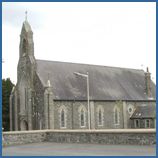
That forgiveness has had and has always been offered to us by Jesus who emptied himself for us, as we have heard proclaimed in our second reading by St Paul, writing to the Philippians. Jesus gave of himself completely on the Cross, the sacrifice we remember in the Mass – the source of the faith of our previous generations, of all the good we can possibly do. The Eucharist sustains, indeed, nourishes us, into new life and anticipates eternal life in communion with God. It was that belief in the Mass which inspired the building of a church in 1750, and the construction of this Church of the Immaculate Conception in 1926 – we give thanks today.
We are called today by St Paul, to be of the same mind as Jesus Christ. We are invited to be self-effacing in considering the other person to be better. In other words, we are, especially, in the fast-moving world of today invited, to grasp that goodness within the other person, especially, in the newcomer, within the stranger in our midst, whom we acknowledge on this World Day of Migrants & Refugees. These are people, who deserve our focus, as their situation remains as one of the key issues of our time. It’s a global issue, that has national and local impacts today.
In order to walk the talk, to live out our Christian calling today, we can be guided by the faith tradition we have inherited. We must continue to grasp the dignity, the integrity of our own calling, see those qualities in others and act on them with God’s help. On this World Day of Migrants & Refugees we are challenged to recognise the plight of the other person or persons. Indeed, we must grapple with the causes of the inequalities of our world that are giving rise to the mass migration of peoples. In this Season of Creation, we are called to an awareness of how climate change, driven by our dependence on fossil fuels in this part of the world, is causing war and poverty elsewhere, thus leading, in part, to migration. We are challenged to change our ways, to reconsider our sources of energy.
In the meantime, we must appreciate that everyone deserves to have their human rights respected within the context of a new fundamental appreciation of life, of all of life; human from conception and natural. On this Sunday, as we celebrate our Centenary, we are invited to continue with our commitment to our faith by addressing the issues of our day, of welcoming the migrant, the refugee, of appreciating the dignity of their personhood, of how God has a purpose for everyone in life. Today, we are asked to be of service in upholding the integrity, the dignity of that God given purpose of each person as well as protecting God’s gift of creation.
Thanks.
Thanks, to all involved, especially, to Jim Hannon, who provided us all with a context, with the historical background to our celebration today. You have heard of the Trinity. What of the Trinity of the Tipperary men. You may have noted that at the opening and blessing of this Church of the Immaculate Conception in 1926, Bishop Patrick Finnegan was accompanied by Bishop Joseph Shanahan, the founder of the Missionary Sisters of the Holy Rosary, the Killeshandra Sisters and a Tipperary man. Today, you have myself from Mid–Tipperary, you had Bishop Shanahan from North Tipperary in 1926 and today you have Jim Hannon from West Tipperary – sure he is the tangible bridge or the link between 1926 and 2026 having lived for most of those years in between.